

Operation Sindoor just a pause: India will not be deterred by N-threats, Modi sends stern message to Pakistan


New Delhi, May 12. In a nationally televised address, Prime Minister Narendra Modi on Monday evening praised the Indian armed forces for the success of Operation Sindoor, calling it a historic and decisive response to the Pahalgam terror attack that claimed dozens of innocent lives on April 22. He declared the operation as a turning point in India’s counter-terrorism strategy and a strong message to those sponsoring cross-border violence.
Opening his speech, Prime Minister Modi saluted the courage of India’s armed forces, intelligence agencies, and scientists for their role in the operation.
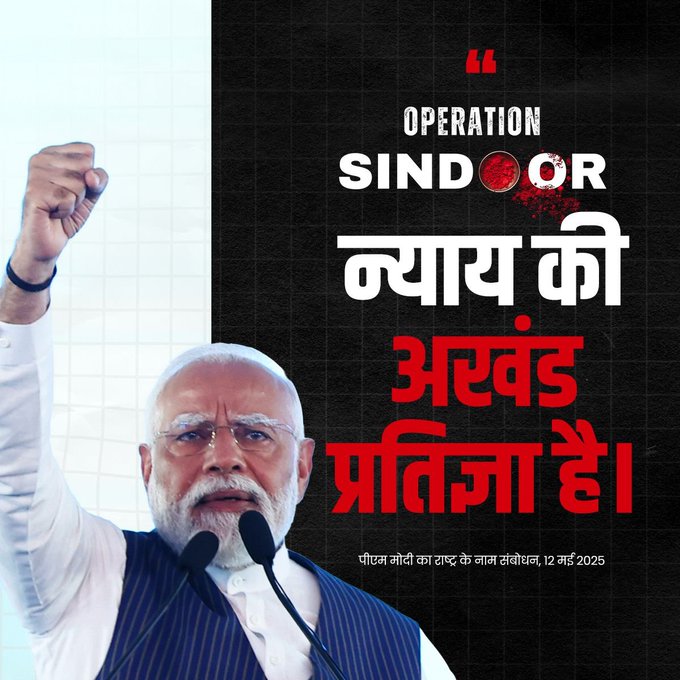
“Operation Sindoor is a reflection of the collective will of millions of Indians. It is our unwavering commitment to justice,” he said, dedicating the mission’s success to “every mother, sister, and daughter of the country”.

The Pahalgam attack, in which terrorists targeted civilians based on their religion, was described by Modi as a “barbaric and gruesome” attempt to disrupt India’s communal harmony. He said the entire nation, cutting across political lines, stood united in demanding strong action. Following this consensus, Indian forces were given a free hand to respond decisively.
According to the Prime Minister, in the early hours of May 7, India launched precise strikes on terror training centers and hideouts deep inside Pakistan, targeting hubs like Bahawalpur and Muridke – locations he termed as “universities of global terrorism.” Over 100 high-value terrorists were reportedly neutralised, including leaders who had evaded justice for decades.
“Pakistan never imagined such a bold step from India,” Modi said, adding that the strikes not only destroyed infrastructure but also shattered the morale of terror groups. He emphasised that the operation sent a clear signal: India will not tolerate attacks on its sovereignty or dignity.
In retaliation, Pakistan launched strikes on civilian and military targets in India, targeting schools, religious sites, and army bases. However, Modi said India’s air defence systems intercepted most threats and that Pakistan’s retaliation exposed its true intentions before the international community.
India, he said, responded with superior firepower and technology, damaging several key Pakistani airbases.
“Within three days, we caused damage Pakistan could not have imagined,” Modi noted. He claimed that it was only after these heavy losses that Pakistan’s military contacted India’s Director General of Military Operations (DGMO) on May 10, appealing for a halt to hostilities.

While India has paused further strikes, the Prime Minister made it clear that this is not a permanent truce.
“We are closely watching every move Pakistan makes. Our response in the future will depend on their behavior,” he warned.
Modi outlined a new three-pronged doctrine emerging from Operation Sindoor:
- India will respond firmly and on its own terms to any terror attack.
- India will no longer be deterred by nuclear threats, and will strike terror camps even under nuclear blackmail.
- India will treat terror sponsors and masterminds as one – no distinction will be made between terrorists and those who protect them.
Highlighting the global roots of terrorism emanating from Pakistani soil, Modi pointed to past international attacks like 9/11 and the London Tube bombings, alleging links to Pakistan-based terror infrastructure. He also accused senior Pakistani military officials of honoring slain terrorists – proof, he said, of state-sponsored terrorism.
The Prime Minister hailed the effectiveness of ‘Made in India’ weapons during the operation, calling it a testament to the country’s growing defense capabilities in modern warfare.
He also stressed the importance of unity in the face of terrorism and reiterated India’s firm position: “Terror and talks cannot go together. Terror and trade cannot go together. Water and blood cannot flow together.”
He warned that Pakistan would face internal collapse if it continued to shelter terror outfits.
“If Pakistan wants peace, it must dismantle its terror infrastructure. There is no other way forward,” he said.
On the occasion of Buddha Purnima, Modi concluded with a message of strength and peace.
“The path of peace goes through power. A strong India is essential for a peaceful and developed India,” he said.
In a final salute, he bowed to the valour of the Indian armed forces and reaffirmed the nation’s commitment to securing peace through strength.


