


By Muskan Chhabra
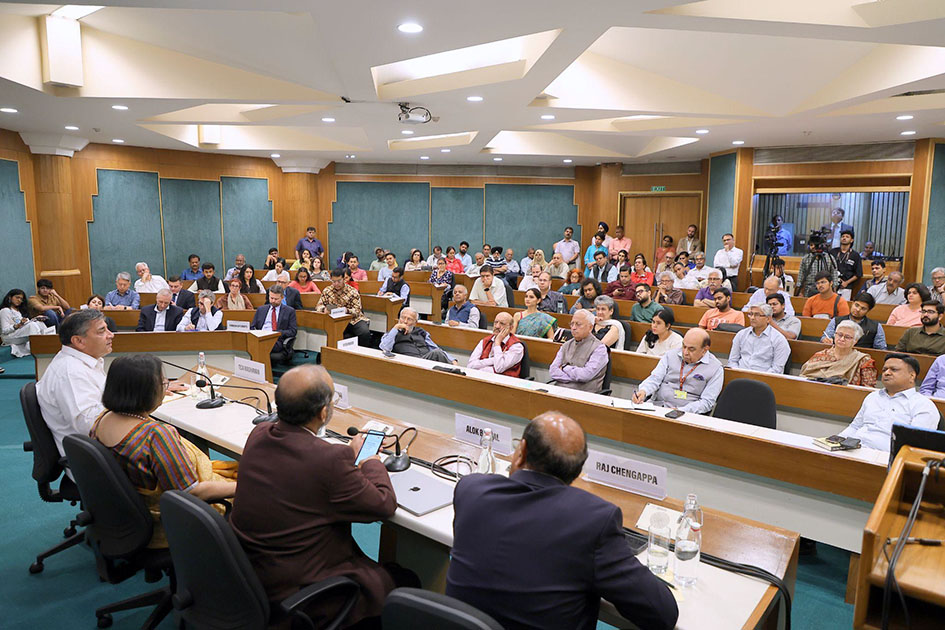
New Delhi. On 3 June 2025, the India Foundation, in collaboration with the India Habitat Centre, hosted a panel discussion titled “India-Pakistan Relations in Light of Operation Sindoor.”
Policymakers, security specialists, and scholars assembled to analyse the evolving nature of India-Pakistan relations following Operation Sindoor, the historic military operation launched by India to avenge the brutal terrorist attack that occurred on 22 April 2025 on Hindu tourists in the Pahalgam region of Jammu & Kashmir. The operation, which began on 7 May 2025, has been temporarily halted (as PM Modi mentioned that Operation Sindoor has not yet been completed).

Ambassador Ruchi Ghanashyam, former Indian High Commissioner to the United Kingdom; Ambassador T.C.A. Raghavan, former Indian High Commissioner to Pakistan and former Director General of the Indian Council of World Affairs (ICWA); and Mr Raj Chengappa, Senior Journalist & Group Editorial Director (Publishing) of India Today Group, participated in the panel.
It was argued that longstanding hostility between India and Pakistan originating from the 1947 partition and has been worsened by Pakistan army’s intensifying employment of military attacks and terrorism. And strategic mistrust has never really relaxed despite some sincere efforts from both sides.
The current situation, according to the panel, is an “interface with minimal to no interaction between the governments of two nuclear-armed countries,” emphasizing the lack of a meaningful bilateral relationship.
The terrorist attack in Pahalgam, Jammu and Kashmir, on 22 April 2025, which targeted Hindu men and resulted in the death of 26 civilians, including tourists, disrupted this minimal interface. India launched Operation Sindoor in response, after attributing the attack to Pakistan-backed organisations, including Jaish-e-Mohammed and Lashkar-e-Taiba.

Strategic Restraint
Operation Sindoor significantly changed India’s longstanding policy of strategic restraint.
Targeting nine terrorist infrastructure sites in Pakistan and Pakistan-occupied Kashmir (PoK), including strongholds in Bahawalpur and Muridke, the operation was launched in the early hours of 7 May 2025 and involved precise missile and air strikes. India’s modern military capabilities were demonstrated by the Indian Air Force, which used Rafale fighters equipped with SCALP missiles, BrahMos cruise missiles, and Israeli-made SkyStriker loitering munitions.
The operation, described as “focused, measured, and non-escalatory,” initially avoided directly attacking Pakistani military installations but, in response to Pakistan’s retaliatory strikes targeting both civilian and military infrastructure, ultimately targeted strategically vital assets of Pakistan, including airbases such as Nur Khan, Rahim Yar Khan, and Sargodha.
The tri-service operation, which employed local systems such as BrahMos and Akash, proved that India could conduct multi-domain operations deep within Pakistani territory.
India’s security apparatus experienced a conceptual shift following the Pahalgam attack, prioritising kinetic action over persistent non-kinetic pressure. A new military paradigm emerged through Operation Sindoor, demonstrating that India was prepared to target military objectives deep within Pakistan if any future terror attacks on India and its citizens occurred.

From Soft Power to Hard Power
As Ambassador Raghavan noted, this change indicated India’s move from a primarily soft power approach to one that includes hard power, laying the foundation for geopolitical assertiveness in a complex region.
The operation clearly conveyed India’s intention to punish Pakistan severely for its employment and support of terrorism, a stance further reinforced by suspending the Indus Water Treaty (IWT). The suspension, described as a standard diplomatic move, heightened the stakes for Pakistan’s policy to use terror in the name of Islam, and signaled India’s willingness to utilise non-military means also to increase pressure.
In his introductory remarks, Chengappa emphasised the escalating dynamics caused by Operation Sindoor.
He noted that India’s tactical victories were sometimes overshadowed by Pakistan’s successful information warfare, which gained some international attention. Chengappa states that the operation triggered a cycle of retribution, with Pakistan launching airstrikes, short-range missiles, and drone swarms on Indian military installations, initiating an intense Electronic Warfare (EW) campaign. He emphasized that Pakistan was able to portray the conflict as an example of its resilience, as India’s initial silence allowed it to control the narrative.
Chengappa further explained that Operation Sindoor was a “demonstration of decisive force.”
Hit Back Harder Each Time
Notably, Prime Minister Narendra Modi’s order to “up the ante each time” has signified a new normal in India’s approach to terrorism.
He has warned that the lack of strong diplomatic channels risked further escalation, even while acknowledging that India’s attacks aimed at the “head of the snake,” not just foot soldiers.
Ambassador Ghanashyam argued that soft diplomacy has inherent limitations when engaging with a military system that depends on a conflict-driven narrative. Drawing on her 38 years of diplomatic experience, which included numerous interactions with Pakistan, she highlighted that diplomacy alone cannot suffice to halt Pakistan’s support for terrorism.
She endorsed Operation Sindoor as a crucial step towards decisive action. Ambassador Ghanashyam’s perspective aligned with the prevailing view that to effectively counter Pakistan’s provocations, India must combine diplomatic efforts with assertive military measures.
Ambassador Raghavan emphasised that India has a responsibility to maintain a strong deterrence against such situations following Operation Sindoor.
He highlighted the strategic importance of maintaining a credible military stance by describing the operation as a “weighty but necessary and justified step” in response to the Pahalgam attack.
The “Rashomon Effect” in India-Pakistan relations was discussed, and Raghavan stressed that India must clarify its strategic objectives to prevent misunderstandings. The “Rashomon Effect”, where India and Pakistan interpret and view the same incidents differently, has been an ongoing issue.
Operation Sindoor Marks India’s Zero Tolerance to Terror Tools
The message behind Operation Sindoor—India’s zero-tolerance stance on terrorism—was misunderstood in Pakistan, which regarded the operation’s 60-40 victory for India as a triumph. Pakistan’s military framed the action as a successful deterrent against a larger adversary, fostering a sense of triumph within the country.
Chengappa pointed out that this narrative was influenced by Pakistan’s successful information warfare, which was emphasised on social media and websites such as X.
For example, India’s story was muddied by its refusal to deny possible aircraft losses, while Pakistan’s unsubstantiated allegations of downing Indian aircraft gained credence. To align narratives and reduce misunderstandings, the panel emphasised the importance of communicating India’s strategic aims more clearly.
As demonstrated by the tit-for-tat retaliations that followed Operation Sindoor, which included Pakistani drone operations and missile strikes on Indian sites, the absence of strong diplomatic channels exacerbated this issue.
The years 2021–2025 were seen as a period of limited stability, characterised by mature responses to incidents such as the BrahMos misfire and the 2021 truce, yet no progress was made on major issues like terrorism or the Kashmir dispute.
Despite the tactical success of Operation Sindoor, neither militarism nor diplomacy has produced conclusive results because neither nation holds a unilateral advantage. Although India’s military campaign increased the costs for Pakistan’s employment of terror tools, the panel noted that despite many advances, the bilateral relationship between the two countries still struggles to move forward.
Modi Doctrine of No Nuclear Blackmail
The rules of engagement have been reset by Operation Sindoor, which established the so-called “Modi Doctrine”: no nuclear blackmail, cross-border terrorism to be regarded as an act of war, and the link between blood and water, in an indirect reference to the Indus Water Treaty.
India’s Military Industrial Strength
India’s military-industrial independence was demonstrated through the operation’s success in destroying Pakistani airbases and targeting terrorist infrastructure, with local systems outperforming Pakistan’s Chinese-supplied weapons.
However, the panel did issue a warning that Pakistan’s economic limitations and dependence on external assistance (such as from China) may hinder its ability to sustain conventional deterrence and could even compel it to adopt riskier tactics. To promote stability, the panel advocated for a strategic reassessment at the conclusion.
The panel made specific recommendations, including:
- Improved Communication: To counter Pakistan’s narrative and ensure its strategic objectives are understood, India must make substantial investments in information warfare. It argued that in this age of informational warfare, proper dissemination of information from the highest levels of government is crucial.
- Diplomatic Engagement: While diplomacy alone is insufficient, reviving channels such as the existing DGMO hotline might help prevent unforeseen escalation. It can assist in avoiding the escalation of the situation in case of any misunderstanding. In the past, it has been effective in easing tensions, as demonstrated in the case of the BrahMos misfire on Pakistan.
- Sustained Deterrence: Building on the achievements of Operation Sindoor, India should continue to project a credible military stance to deter future provocations. It must never lower its guard and must maintain strong vigilance over the activities of both Pakistani state and non-state actors.
- International Advocacy: Following Operation Sindoor, India dispatched all-party delegations to key capitals as part of a proactive diplomatic effort to unite against cross-border terrorism. It should persist with such initiatives that not only help in shaping India’s narrative but also present India as a mature democracy with a strong consensus on taking coordinated action against terrorism originating from foreign soil.
Conclusion
Operation Sindoor marked a key turning point in India-Pakistan relations, shifting from strategic restraint to a more proactive and assertive stance.
While the operation’s tactical success was highlighted, the panel discussion also emphasised issues such as narrative mismatch, increasing risks, and the lack of a meaningful bilateral partnership. Even if India has raised the cost of Pakistan army ISI’s for terrorism, efforts to build long-term stability are hampered by the “Rashomon Effect” and Pakistan’s triumphalist narrative.
Together, Chengappa, Ghanashyam, and Raghavan’s insights highlighted the need for a comprehensive strategy that combines strategic communication, hard power, and selective diplomacy to manage the tense India-Pakistan relationship in the years following Operation Sindoor.
(The writer is a Research Fellow, India Foundation).


