


By Gulshan Luthra
Abu Dhabi/ New Delhi. Shaikh Mohamed bin Zayed is the new President of the UAE, a strong country already playing a positive, stabilising role in regional and international affairs. He assumed office on 14 May 2022 after election by the Federal Supreme Council, consisting of the Rulers of the seven Emirates which constituted the federation of the United Arab Emirates on 2nd December, 1971.
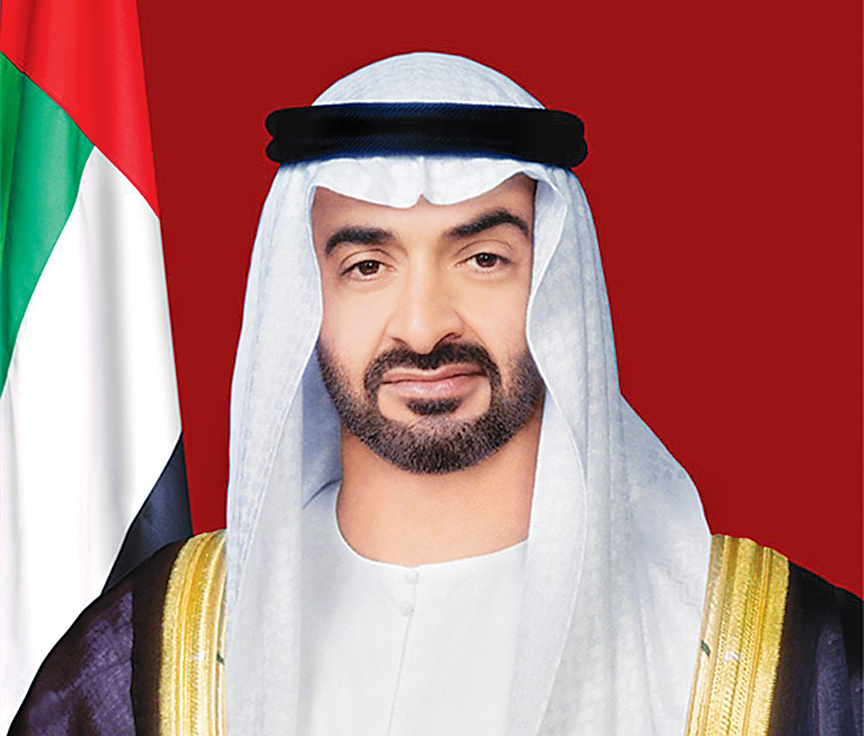
The third President after his father and founder of UAE, Shaikh Zayed bin Sultan al Nahyan, and his elder half-brother Shaikh Khalifa, Shaikh Mohamed is known to be a strong man. In fact, he has effectively been in-charge of the country’s Interior, International, Defence and Strategic affairs for quite long, and has been leading his country’s efforts for strategic reach and stability in the Gulf and Middle East as well as globally. He has built and strengthened bilateral and multilateral equations with leading countries, and with India, has renewed strong bonds of traditional friendship.
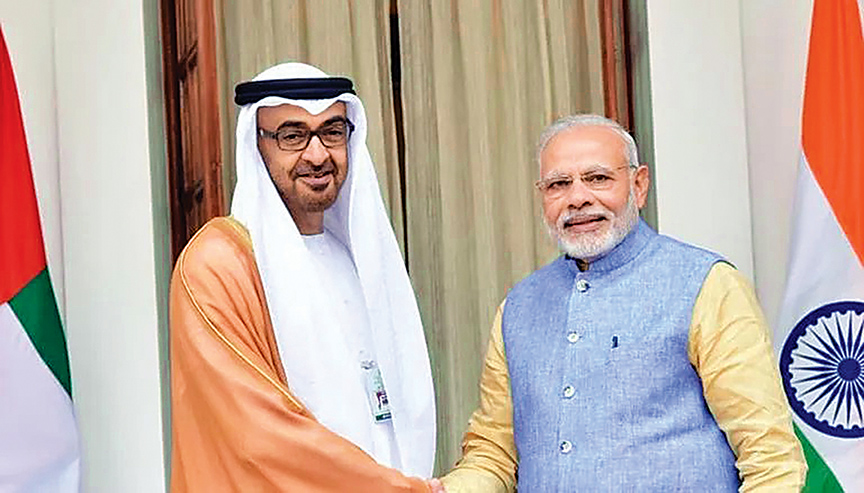
Shaikh Mohamed and Prime Minister Narendra Modi are good friends, and India and the UAE are cooperating in the Middle East towards peace and stability. The two countries share common interests and vision even on global economy, oil and energy.
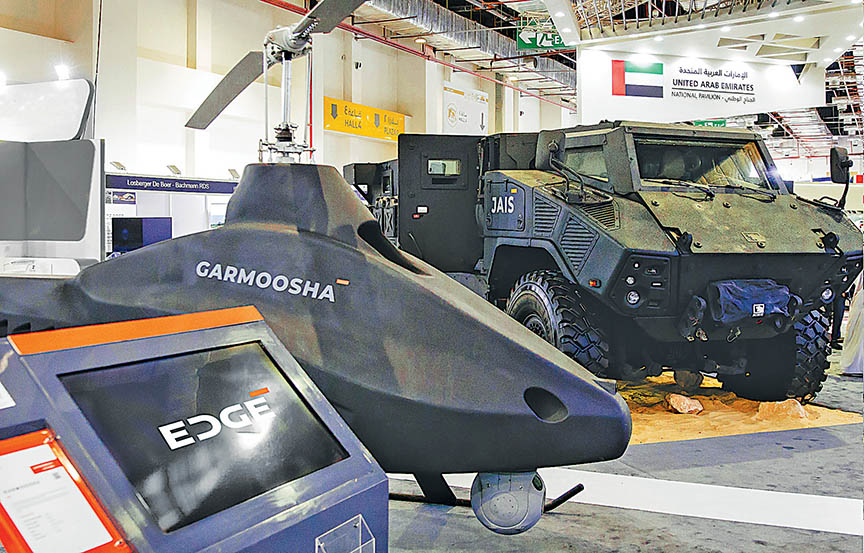
The highly respected President Shaikh Zayed had initiated a visionary policy of Offsets in Technology and Investments way back in the 1980s for major industries like oil and defence. Building on that legacy, Shaikh Mohamed has consolidated the UAE’s Defence Industrial Base by setting up EDGE, a conglomerate of a spectrum of defence companies for indigenous manufacturing of Aircraft, Guns, Ships, Tanks, Armoured Vehicles, Radar and Small Arms etc.
Technology has been sourced from top global companies, and the country already manufactures and supplies components in Offset arrangements, including for civil aircraft. There is emphasis on Precision Systems and Satellite connectivity.
Some of the key systems already being Made in the UAE with foreign collaboration and technology insertion are Drones for Surveillance and Reconnaissance as well as Armed systems. These drones and Armoured Cars are a shining example, and proudly displayed at the IDEX series of defence exhibitions initiated in 1993 in Abu Dhabi. I have witnessed nearly all of them.
A Daring Pilot
A daring fighter pilot, Shaikh Mohmed has headed his country’s armed forces as the Chief of Staff, and as the Crown Prince of Abu Dhabi and Deputy Supreme Commander of the UAE Armed Forces. As the President of the United Arab Emirates, he is now the Supreme Commander of the UAE Armed Forces, which have taken part in both military and disaster relief operations in other countries including Kuwait, Yemen, Lebanon, and Syria.
Shaikh Mohamed, also known as MBZ, has flown various types of fighter jets. I had the privilege of seeing him take off in a Russian Sukhoi Su 27 from the Dubai Airshow – perhaps in 1995 or around then. UAE eventually chose the US F 16, French Mirage 2005 and Rafale.
There are some complications over technology but discussions are still on between Washington and Abu Dhabi for the supply of General Atomics unmanned and armed MQ 9B SkyGuardian aircraft and Lockheed Martin F 35 Lightening II combat jets. (The issue is over UAE’s selection of the Chinese 5G connectivity and US says it could help Beijing steal critical technology developed and introduced on the American fighters by US companies).

UAE Welcomes Cooperation with IAF
The UAE forces are highly modern, efficient, and respected for their professionalism. They conduct periodic joint exercises with many countries, including with India, and the UAE Air Force has assisted and helped in midair refuelling Indian Air Force Mirage and Rafale combat aircraft while on way back or ferry from France after service and delivery.
The two Air Forces share commonality of aircraft and systems, and have extremely friendly relations and hold periodic joint exercises. At the recent Dubai Airshow 2021, IAF’s Hawk 32 Suryakiran jets, ALH Sarang helicopters and a single Light Combat Aircraft (LCA) enthralled every one by their aerobatics.
UAE in Space
MBZ is known for his keen interest in Space.
The UAE Space Agency was created in 2014, and Space Sciences are being taught to students in Higher Education. Its aims, declared in 2015, were to train young Emiratis in scientific research and technologies, enhance cooperation with other countries, and of course, Reach The Moon and Mars.
There is the Mohammed bin Rashid Space Centre (MBRSC) named after UAE’s Vice President and Prime Minister as well as the Ruler of Dubai. I have had the privilege of visiting this impressive institution, and it is from here that the UAE conducts and controls its space missions as well as training of astronauts.
MBZ and Shaikh Mohammed bin Rashid al Maktroum together make a great team to lead their country and enjoy strong support from the Rulers of five other Emirates, namely, Sharjah, Ajman, Umm al Quwain, Ras al Khaimah and Fujairah.
Notably, the UAE has conducted a Mars mission on the 50th Year of its Independence, in 2021.
UAE and India Relations
UAE’s main defence suppliers are the US, France, Britain, Germany and Russia. Some discussions are on between India and the UAE, with Abu Dhabi indicating interest in the BrahMos missile. In a conversation with India Strategic, Late Defence Minister Manohar Parrikar had indicated the possibility of $ 2 Billion defence trade between the two countries.
A friend of India for long, Shaikh Mohamed has always had good relations with Indian leaders, and due to the intrinsic warmth he displays, he draws a lot of appreciation all over the world of statesmanship.
In 1995, I recall, India had taken part in a big way in the second edition of UAE’s Land and Naval show, IDEX’95. An official of the Defence Research and Development Organisation (DRDO), Col Umang Kapur, went to his office and requested him to visit the Indian pavilion. With great humility, Shaikh Mohamed came and looked at models of HAL’s LCA and ALH and other systems. The then Secretary Defence Production, Mr Vijay Kapur, who was around, immediately followed with an invitation for him to visit India, and Shaikh Mohamed was kind to come.
In 2003, Shaikh Mohamed, then Chief of Staff, was accorded a very warm welcome in New Delhi by Deputy Prime Minister and Home Minister LK Advani and External Affairs Minister Yashwant Sinha.
Prime Minister AB Vajpayee, a bit unwell then, received the foreign dignitary and there was a formal Strategic Dialogue with Indian Ambassador in Abu Dhabi KC Singh observing that the initiative would help institutionalise periodic bilateral exchange of views and cooperation for the future.
Shaikh Mohamed was accompanied by Information Minister Shaikh Abdulla bin Zayed and Head of the Economic Department Shaikh Hamid bin Zayed.
In 2016, Mr Modi broke protocol to personally welcome the UAE leader, describing him as a special friend and visionary leader. An Indo-UAE Comprehensive Strategic Partnership was signed between the two countries then.
Today, Shaikh Mohamed and Indian Prime Minister Narendra Modi particularly share a good friendship, have met a few times, and the Indian Prime Minister was among the first to congratulate him on his succession. “I am confident that under his dynamic and visionary leadership, our Comprehensive Strategic Partnership will continue to deepen,” Mr Modi said in a tweet.
That is happening. The Ambassador has proved right.


