

Airbus starts Galileo Second Generation satellite production
Manufacturing of six state-of-the-art GNSS satellites to augment current Galileo constellation

Friedrichshafen, December 1. Full production has begun on the six Galileo Second Generation (G2) satellites at Airbus’ site in Friedrichshafen, Germany, with the arrival of the first satellite Flight Model structure from Beyond Gravity in Zurich. After initial preparation the panels will be dispatched to other Airbus sites before final integration and testing at Friedrichshafen. The Galileo G2 satellites are scheduled for launch in the coming years to support the initial deployment and validation of the G2 System.
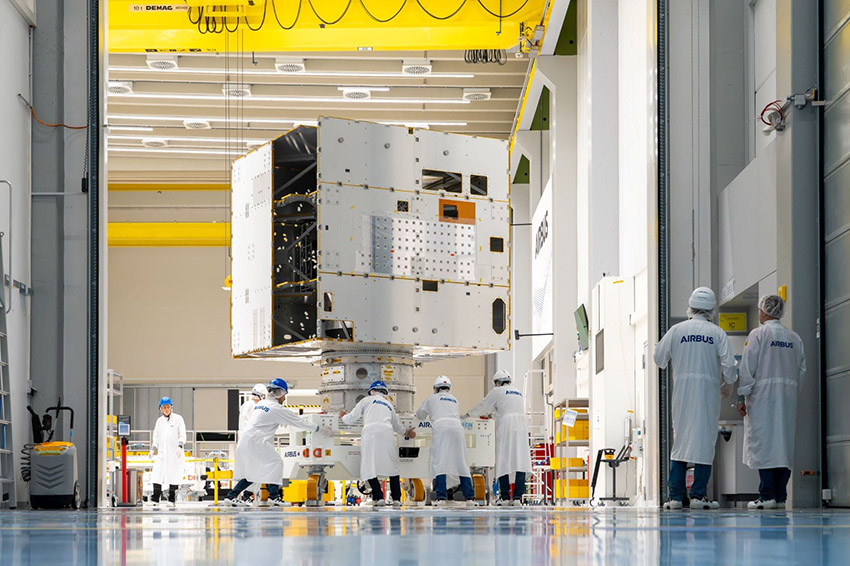
Jean-Marc Nasr, Head of Space Systems at Airbus, said: “After the successful design phase we are now kicking off production in earnest of the state-of-the-art Galileo G2 satellites. Our teams in Friedrichshafen are working with engineers across Europe to meet the challenging schedule and finalise these sophisticated satellites which will further improve the global Galileo system opening up even more opportunities for services on Earth.”
To meet the demanding schedule to deliver all six satellites in less than two years, Airbus has developed a coordinated production programme to leverage the spacecraft manufacturing, integration, and testing expertise across Airbus sites including Backnang (near Stuttgart), Friedrichshafen, Madrid, Ottobrunn (near Munich) and Toulouse. The second satellite structure is due to arrive in early 2024 and the third towards the end of next year. Airbus’ modular approach to the manufacturing of the G2 satellites will see three spacecraft being produced in parallel at any one time.
The G2 satellites will incorporate enhanced navigation antennas which will help improve accuracy of the flagship European Global Navigation Satellite System. The spacecraft, equipped with electric propulsion for the first time and higher-strength navigation antennas, will also feature fully digital payloads which will be easily reconfigured in orbit, enabling them to actively respond to the evolving needs of users with novel signals and services.
ESA’s Director of Navigation Javier Benedicto said: “This new milestone is a testament to the capabilities and dedication of the European industry and reaffirms ESA’s commitment to redefine the boundaries of satellite navigation. I cannot wait to see the many parts come together to bring to life an even better performing Galileo system, so this EU programme can continue serving European and world citizens.”
The above 2 tons satellites, which benefit from Airbus’ heritage of the highly reliable Eurostar series of telecommunications satellites, will also incorporate six (rather than four) enhanced atomic clocks as well as inter-satellite links, enabling them to communicate and cross-check with one another. This is intended to offer decimetre-scale precision positioning for users around the world. They will be controllable with an increased data rate to and from the ground and equipped with advanced jamming and spoofing protection mechanisms to safeguard Galileo signals. The spacecraft will operate in orbit for 15 years.
The Full Operational Capability phase of the Galileo programme is managed and funded by the European Union. The European Commission and ESA have signed an agreement by which ESA acts as design authority and system development prime on behalf of the Commission.
The views expressed in this Press Release can in no way be taken to reflect the opinion of the European Union and/or ESA. “Galileo” is registered as a trademark in the database of the European Union Intellectual Property Office (n° 002742237).


