


- ISRO’s emergence as a key player in the global space sector
- Fifty-four-year-old Indian Space Agency ISRO, is not only the world’s most cost-effective agency but it is also fast proving to be one of the most successful incubators of private space firms
By R. Anil Kumar
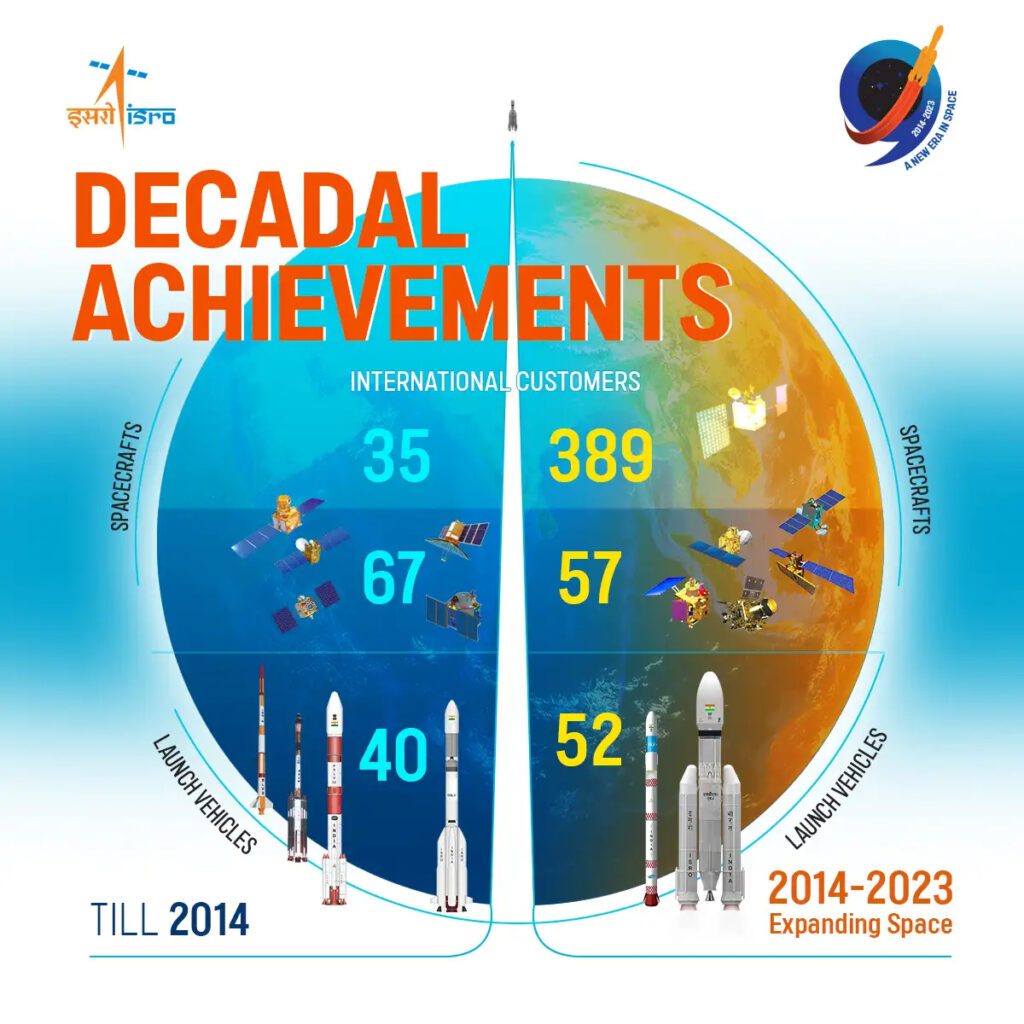 Bangalore, September 29. India has emerged as a “key player” in a growing global commercial market for space-based surveillance and communication.
From carrying rocket cones on bicycles and ferrying satellites on bullock carts to successfully sending an orbiter to Mars in the first attempt to making India the first spacefaring nation to land near the moon’s South Pole—the Indian Space Research Organisation (ISRO),trajectory of accomplishments has been nothing short of awe-inspiring.
The world’s sixth-largest space agency, indeed has come a long way. Fifty-four-year-old ISRO is not only the world’s most cost-effective agency but it is also fast proving to be one of the most successful incubators of private space firms.
In the process, the Indian space agency has even managed to make a mark in the world of space exploration. For instance, the Mangalyaan and Chandrayaan missions were achieved on shoestring budgets of $73 million and $75 million, respectively, lesser than the money spent on making Hollywood science fiction blockbusters Gravity ($100 million) and The Martian ($108 million).
But as is evident, ISRO’s frugality has its roots in its very humble origins. Vikram Sarabhai—widely hailed as the father of India’s space programme—started a small space lab in the garage of his Ahmedabad residence. Starting out as the Indian National Committee for Space Research (INCOSPAR), ISRO formally came into being on August 15, 1969.
Fifty-four years later, ISRO is fast evolving into an agency that is enabling the creation of one of the world’s biggest spacetech ecosystems.
 It has incubated and nurtured firms over the years to a point where the sector has reached critical mass and can boast of over 400 companies that are now looking to strike out on their own in activities like launch services, satellite communications, and space tourism.
And all of this has been built with that same ethos of frugality and pragmatism. That was made amply clear by ISRO Chairman S. Somanath at the Indian Space Congress in July this year.
“India, is a country where if you like giving it [for] free, it’s very good. You will be building a huge business. But then, of course, there needs to be a business model,” Somanath told a cross-section of stakeholders.
A strong proponent of taking satellite communications to the masses, Somanath has been pushing hard to also make the technology affordable. “We have to find ways through which on-ground infrastructure and connectivity are actually delivered to people in millions at an extremely low cost.”
The satellite internet market is expected to touch a 27 per cent share of the global space industry by 2040, a massive increase over its current share of less than 1 per cent, according to a Deloitte study.
Moreover, satellite manufacturing, satellite launch, commercial human spaceflight and commercial remote sensing are also likely to gain substantially. Crucially, the government spending component, that has been considerable all these years, is expected to fall from 27 per cent in 2021 to less than 18 per cent by 2040. ISRO will cede space to the private sector to drive future growth.
Though often touted as the world’s lowest cost yet most successful space agency, contrary to popular belief ISRO has never been managed as a company as it always worked with a somewhat altruistic agenda.
For instance, the revenue earned from foreign and domestic satellite launches would earlier go into the Department of Space’s (DoS) balance sheet. After NewSpace India Ltd (NSIL) was formed in 2019, it takes care of all commercial activities after buying ready-made assets and services from ISRO.
That money makes its way to the balance sheet of the DoS, which in turn funds ISRO. NSIL is a profitable entity—in FY22, it recorded profit after tax of Rs 342.98 crore. Its revenue zoomed from Rs 321.77 crore in FY20 to Rs 1,731 crore in FY22.
Therefore, as part of the opening of the Indian space ecosystem to private participation since 2020, ISRO is playing a key role in transforming the sector from a supply-based model to a demand-based one.
It has already started helping with capacity building through the development of new technologies and capabilities, technology transfers to private players and sharing its facilities with NSIL and Non-Government Private Entities.
It is also making an all-out effort to retain India’s position as a low-cost yet reliable satellite launch services provider. And it aims to maintain this leadership position in the arena through the Small Satellite Launch Vehicle (SSLV) and a reusable rocket.
India, as a late entrant to the global commercial space sector, has no time to spare in this highly competitive marketplace.

At one time, the Country had about a 2 per cent share of the international commercial space launch market.
Therefore, even as the orbit economy booms, the cost of satellite launches continues to decline, and competition promises to get ever more cut-throat, the country remains in the reckoning.
The SSLV was conceived after increased demand for launch vehicles with a quick turnaround time to put small satellite constellations in the Lower Earth Orbit (LEO). It is an all-solid fuel-powered three-stage vehicle capable of launching mini, micro or nano class satellites in the 10-500 kg range.
“The SSLV was created as an industry-friendly rocket, and we would like to transfer this rocket to the industry at the earliest. The industry will be given the whole technology to build and operate it to support small satellite constellations at manageable costs,” ISRO Chairman Somanath said.
Following a process initiated by the Indian National Space Promotion and Authorisation Centre (IN-SPACe)—the single-window nodal agency for authorising, promoting and regulating private players in the space sector—a total of 23 private players have expressed interest in building the SSLV launch vehicle after the technology transfer from the national space agency.
Somanath has also sought the private sector’s support in expediting its reusable rocket programme to compete with Elon Musk’s SpaceX.
He has already committed ISRO’s support in working with the private sector in designing the complex technology that will go into building the reusable rockets.
“The rocket has to be owned and operated by business houses to not only handle more payloads commercially but also be able to increase its numbers whenever required. This vehicle needs to be realised in the shortest possible time because time is running out,” cautions Somanath.
His sense of urgency can be gauged from the successes that SpaceX has had with the Falcon 9 rocket, in terms of bringing down the cost of launching payloads in LEO to as low as $2,700 per kg. And a successful deployment of its under-development Starship will see this crashing further to as low as $10 per kg.
But looking at the list of its overly ambitious space missions planned as well as the can-do attitude, ISRO may spring a surprise with a far cheaper, yet more reliable, alternative.


