


By R. Anil Kumar
Synopsis:
- European Space Agency (ESA) has selected Indian Space Research Organisation’s (ISRO’S) Polar Satellite Launch Vehicle (PSLV) to deploy its experimental Project for On-Board Autonomy-3 (PROBA-3) mission
- The launch vehicle of choice for this mission is the reliable PSLV-XL rocket, operated by the Indian Space Research Organisation (ISRO)
- PSLV has been one of the most reliable launch vehicles in the world and has served as the embarking point for some of the most notable Indian space missions
- The duo of satellites will align to create a 144-meter long solar coronagraph
Bangalore, January 6. In a Significant collaboration India is set to launch the European Space Agency’s (ESA) pioneering Proba-3 mission in September 2024.
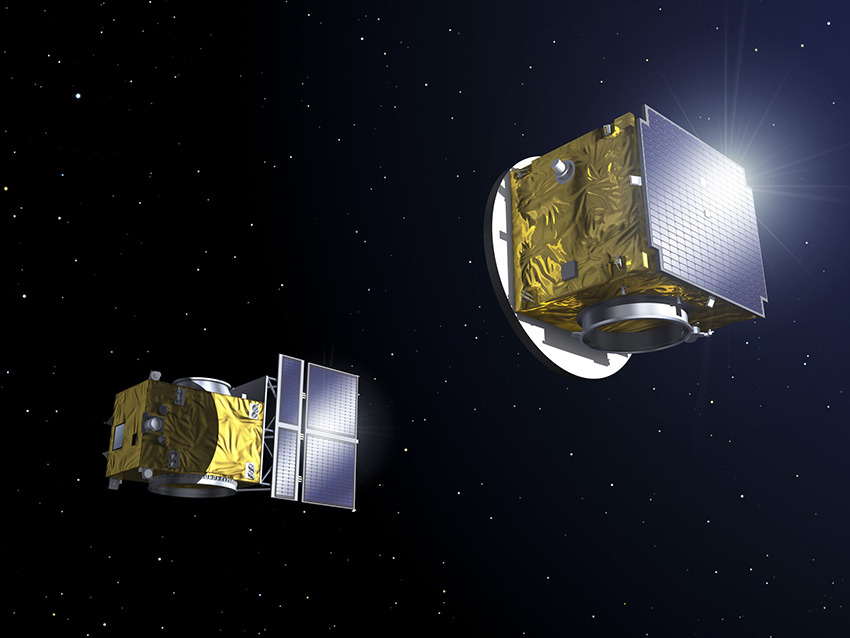
The Indian Space Research Organisation (ISRO) is helping European scientists to make this dream a reality. Proba 3 will launch from ISRO’s Polar Satellite Launch Vehicle (PSLV) launcher from India later this year. PSLV has been one of the most reliable launch vehicles in the world and has served as the embarking point for some of the most notable Indian space missions, including Chandrayaan-1 and the recent Aditya-L1 solar mission.
This ambitious project marks the world’s first precision formation flying mission, with a pair of satellites designed to operate in unison as a ‘large rigid structure’ in the vastness of space.
The duo of satellites will align to create a 144-meter long solar coronagraph, an instrument that will allow scientists to study the Sun’s elusive corona with unprecedented proximity and detail.
This region of the Sun, known for its ghostly glow, has been challenging to observe due to the blinding brightness of the solar disk. However, Proba-3 aims to change that by mimicking an artificial eclipse in space, providing a continuous view of the corona closer to the solar rim than ever before.
The mission’s success hinges on the precise positioning and coordination of the two spacecraft. To achieve this, ESA has developed a suite of cutting-edge technologies, including precision cold gas thrusters and vision-based detection systems.
These innovations will enable the satellites to maintain their relative positions with millimetre-scale accuracy, a feat akin to a carefully choreographed cosmic dance.
The Proba-3’s formation flying also serves as a testbed for future multi-satellite missions, which could operate as singular virtual structures. This opens up possibilities for more complex and versatile space systems, potentially revolutionizing how we approach tasks like Earth observation, telecommunications, and deep-space exploration.

The launch vehicle of choice for this mission is the reliable PSLV-XL rocket, operated by the Indian Space Research Organisation (ISRO).
The collaboration between ESA and ISRO exemplifies the growing trend of international partnerships in space endeavours, pooling resources and expertise to push the boundaries of what’s possible.
Artificial eclipse and the science behind it
The Sun’s outer shell, or photosphere, is one of the brightest parts of the star. The blinding light emitted from this region blots out radiation from other layers of the Sun’s atmosphere, making it extremely hard for astronomers to study them. This is true for most of the year, except when we chance upon a lucky total solar eclipse.
The problem is that solar eclipses are excruciatingly brief, and you can only squeeze out so much data in such a short window. Therefore, a bunch of scientists conceptualised the Proba-3 mission, an attempt to manually blur out the Sun, essentially creating an artificial solar eclipse in space.
What’s more, the Indian Space Research Organisation (ISRO) is helping European scientists to make this dream a reality.
Proba-3 is the brainchild of the European Space Agency (ESA) and is the world’s first precision formation flying mission attempting this incredible Sun-blocking endeavour. An “Occulter” spacecraft will fly in front, spreading itself to obstruct as much of the Sun’s light as possible. This will allow the “Coronagraph” spacecraft behind it to photograph the star’s corona — the Sun’s plasma-filled, photosphere-obscured outer atmosphere where solar storms originate and solar wind is born.
Proba-3’s two satellites are currently undergoing final integration in Belgium. Once operational, they will fly in tandem in the Earth’s high orbit, precisely separated by a distance of 150 metres. As mentioned earlier, the Occulter, acting like a mini-Moon, will cast a precise shadow onto the Coronagraph, creating a window to observe the faint corona in unprecedented detail.
The mission concept is so unique. Having such images for hours on end compared to the 5-10 minutes duration of an eclipse event will be spectacular.
Proba-3’s scientific payload also carries the Digital Absolute Radiometer (DARA), measuring the Sun’s total irradiance, providing crucial data on the star’s energy output and its potential influence on Earth’s climate. Scientists are hopeful these measurements will help us understand coronal mass ejections better, which are massive eruptions of solar material that have the potential to disrupt a wide array of our tech, including satellites, aeroplanes and power grids.
While full-scale testing of Proba-3 on Earth is impossible, the team is preparing for the mission by observing the upcoming solar eclipse over North America in April 2024. They will use the same filter wheels developed for Proba-3 to gather data and gain valuable insights into the kind of results they can expect from the space mission.
Proba-3 is scheduled for launch in September 2024, marking the beginning of a new era in solar observation.
ESA’s Solar Orbiter as well as NASA’s Solar Dynamics Observatory (SDO) are equipped with coronagraphs. Typically, the coronagraph is integrated within the spacecraft, but the PROBA-3 mission uses the innovative approach of using two spacecraft flying in tandem, with the Occulter spacecraft observing the corona, and the Coronagraph spacecraft blocking out the face of the Sun.
India’s Aditya L1 mission, on the other hand, uses a Visible Line Emission Coronagraph (VELC), developed by the Indian Institute of Astrophysics (IIA) in Bengaluru.
The two ESA satellites are currently undergoing final integration at a project site near Antwerp in Belgium.
The mission duration is expected to be around two years. The PROBA-3 launch is currently scheduled for between July and September 2024.
ISRO has lined up 16 launch missions in 2024 – the highest in a single year so far. This includes the Proba-3 launch for ESA.


