

Major announcements by Defence Minister during the plenary session of ‘Swavlamban 2.0’

- 5th Positive Indigenisation List, comprising 98 items, of DMA released; Highly complex systems, sensors, weapons & ammunition included
- 76 challenges under DISC 10& DISC 10 PRIME and two under INDUS X also launched
- One-of-a-kind dual-chip debit card ‘SBI NAVeCash Card’ unveiled; Can be used in online mode &also offline while at sea
- India’s defence sector is riding on the boat of innovation: Mr. Rajnath Singh
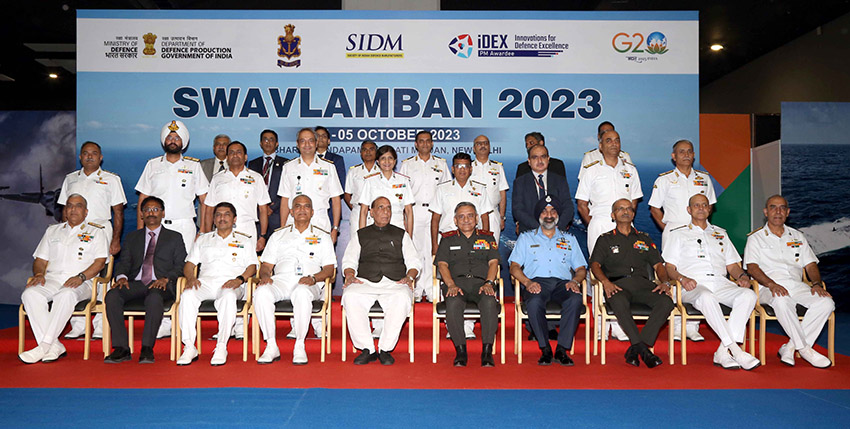
New Delhi. To promote ‘Aatmanirbharta’ in defence and innovation, a number of big-ticket announcements were made by Defence Minister Rajnath Singh during the plenary session of ‘Swavlamban 2.0’, the two-day seminar of Naval Innovation and Indigenisation Organisation (NIIO), which commenced in New Delhi on October 4, 2023. The main highlight was the release of the fifth Positive Indigenisation List of Department of Military Affairs (DMA) comprising 98 items.Highly complex systems, sensors, weapons and ammunition have been included in the list. All these items will be procured from indigenous sources as per provisions given in Defence Acquisition Procedure (DAP) 2020 in staggered timeline.
Mr. Rajnath Singh also launched 76 challenges for the industry under 10th Defence India Start-up Challenges (DISC 10) & DISC 10 PRIME of Innovations for Defence Excellence (iDEX) and five problem statements under iDEX for Fauji. In addition, two INDUS X challenges under ‘INDUS-X Mutual Promotion of Advanced Collaborative Technologies’ (IMPACT) challenges jointly finalised by iDEX and United States Department of Defense (US DoD) were launched by Defence Minister. He also released the Indian Navy’s updated Indigenisation Roadmap ‘Swavlamban 2.0’.A special interactive session for the industry to explain the nuances of the roadmap is planned on Day 2 of the seminar.

In his address, Mr. Rajnath Singh appreciated the fact that the SPRINT innovative challenge, which was launched by Prime Minister Narendra Modi during the maiden Swavlamban seminar in 2022 to promote the use of indigenous technology and products in the Navy, has helped in taking the country forward in becoming self-reliant in the defence sector. He credited the Prime Minister’s visionary leadership for driving the country ahead in mission mode free from doubt and full of confidence. India’s defence sector is currently riding on the boat of innovation, he said, lauding iDEX for providing the youth with a platform to innovate and develop new products, which not only ensures the progress of the start-ups, but also strengthens the country’s defence ecosystem.
Defence Minister was of the view that India has always been self-reliant in the field of knowledge &innovation and when the present Government came to power in 2014, it re-kindled the feeling of being ‘Aatmanirbhar’ in every sector. “Due to foreign invasions, we had forgotten our innovative approach. The word ‘local’ became synonymous with low quality. We’re now freeing ourselves from that mentality. Our Prime Minister launched the ‘Vocal for Local’ campaign and restored respect for local goods. Our youth are now recognising their inner strength and eliminating inner doubts. In the coming times, they will play a big role in the development of the country with their innovative approach and knowledge,” he said.

While Mr. Rajnath Singh commended Department of Defence Production for playing a crucial role in building a self-reliant India through initiatives such as iDEX, NIIO and Technology Development Acceleration Cell (T-DAC), he stated that increased efforts are needed to connect the youth with the defence sector, especially R&D and manufacturing. He also gave a number of suggestions to further improve the efficiency of iDEX.
Defence Minister called for a careful assessment of the technology challenges – whether they are state-of-the-art as per today’s time and whether any better technology is expected in the near future. He stressed the need to ascertain whether a technology is already available somewhere in the market or “we’re just re-inventing the wheel”. He also pointed out that it is essential to assess the viability of a technology from the point of view of the economy. This will provide a better value for money on your R&D expenditure, he said. He pitched for devising a robust mechanism which conducts this analysis before the introduction of any technology or challenge. For this, he said, DDP, DRDO and the Armed Forces can together form an independent body of experts, which can further improve the analysis mechanism.
Mr. Rajnath Singh also recommended the assessment of products and technologies, developed during the previous challenges, as to where they are placed in the market. He stated that in case there are any shortcomings, improvements should be made in that direction. “If there are 50 challenges and all of them are being achieved, it means that we need to increase the level of challenge. This will provide a push to innovation,” he added.
Defence Minister stressed on constant evaluation of work to move forward. He stated that the challenge may be named SPRINT, but there is a need to move ahead like a marathon race. “We don’t just have to cover a few metres; we have to travel miles. It is both SPRINT and MARATHON,” he said.
Speaking on the occasion, Chief of the Naval Staff Admiral R Hari Kumar stated that, last year, the Navy sought solutions to 75 challenges, received more than 1,000 responses, declared 118 winners under DISC 7 SPRINT and SPRINT-PRIME and concluded over 100 technological developmental agreements between iDEX and the industry. He termed these as global firsts, game changers and force multipliers. The Chief of the Naval Staff emphasised that the Navy’s aim is to go beyond linear growth and adopt compounding i.e., one technology leading to multiple offshoots, each in turn, producing numerous products. He expressed satisfaction that the vision has got off to a dream start. He congratulated the defence industry, MSMEs, start-ups and academia for showing the world “what we are capable of”.

Fifth Positive Indigenisation List
The Fifth Positive Indigenisation List has been prepared by DMA after several rounds of consultations with all stakeholders. It lays special focus on import substitution of components of major systems besides important platforms, weapon system &sensors and munitions which are being developed and likely to translate into firm orders in the next five to ten years.
Prominent items include Futuristic Infantry Combat Vehicle, Articulated All-Terrain Vehicles, Remotely Piloted Air Borne Vehicles upto 25 Km with 2Kg Payload for Army, Naval Shipborne Unmanned Aerial System, Medium Upgrade Low Endurance Class Tactical Drone, Electric Light Vehicle for Army, Medium Range Precision Kill System for Artillery, Next Generation Low Level Light Radar for Army, Automatic Chemical Agent Detection & Alarm System, Armoured Fighting Vehicle (AFV) Protection and Counter Measures System, Integrated Mobile Camouflage System, AI Based Satellite Image Analysis, Test Equipment for Guided Weapon System for Tank T- 90 S/SK, Quantum Key Distribution System for Optic Fiber based Networks (Upto 200 Km range), Very High Frequency Radar, Electro Optic Fire Control System for Naval Platforms, Armour Plates for Cabin Nose Section for Mi-17 Helicopter, Automated Mobile Test System for OSA-AK-M Missile System; Multifunction Aviation Ground Equipment for Air Force, Gravity Rollers for Mi-17 V5 Helicopter and flares of P-8I and MiG 29-K Aircraft.
The items in the list will provide ample visibility and opportunity to the domestic industry to understand the trend and futuristic needs of the Armed Forces and creater equisite R&D and manufacturing capacity within the country.
The MoD has taken numerous steps for self-reliance in the defence sector and Positive Indigenisation Lists is one of the most important transformative reforms in pursuit of indigenisation. It is one of the key constituents of the Government’s ‘Aatmanirbhar Bharat Abhiyan’ to transform the defence sectorto achieve self-reliance and boost exports with the active participation of public and private sector. The DMA had earlier promulgated four Positive Indigenisation Lists comprising 411 military items. Separately, the DDP has notified four Positive Indigenisation Lists consisting of a total of 4,666 items, including Line Replacement Units/Sub-systems/Spares & Components for Defence Public Sector Undertakings (DPSUs).
It is encouraging to note that with the various reforms put in by the Government, the industry, especially the private sector, is gaining confidence and building capability to manufacture/integrate highly complex systems, sensors, simulator, weapons and ammunitions etc. It is likely to stimulate the potential of domestic R&D by attracting fresh investment into technology and manufacturing capabilities. Besides recognising the growing capability of domestic industry in defence manufacturing, the Positive Indigenisation Lists have signalled a strong resolve to promote a robust and self-reliant defence industry and cut down imports. It also recognises the fact that the defence sector will be one of the key contributors to the nation’s economy and growth in the next five to 10 years.

iDEX DISC 10 & DISC 10 PRIME Challenges
76 challenges were launched for the industry by Defence Minister under DISC 10 & DISC 10 PRIME to celebrate the 76thyear of India’s independence. These challenges include problem statements from the three Services, Indian Coast Guard, DPSUs, Border Roads Organisation and Mission DefSpace. In addition, five problems under the iDEX for Fauji (i4F) scheme were also launched.
INDUS X Challenges
iDEX in partnership with the US DoD had recently conducted the India-US Defence Acceleration Ecosystem (INDUS X) event in Washington DC to expand the strategic technology partnership and defence industrial cooperation between the start-up ecosystems, businesses and academic institutes of India and US. In a short span of three months, iDEX and US DoD have finalised two joint INDUS X challenges under the IMPACT which were launched by Defence Minister during the seminar. US Ambassador to India Mr Eric Garcetti was also present at the launch.
iDEX winners, and especially those who have already been awarded procurement contracts, were felicitated during the event.
INVenT
The NIIO and the Defence Innovation Organisation (DIO) entered into an agreement for jointly working on facilitating the infusion of Venture Capital into the defence ecosystem through the iDEX Innovators Hub (iIH). The seminar witnessed ‘INVenT’ (iDEX-Navy Venture for Technology) being launched. In addition, a number of other MoUs were exchanged. These include NIIO MoUs with the academia and the industry.
SBI NAVeCash Card
Defence Minister Rajnath Singh also launched SBI NAVeCash Card – a one-of-its-kind dual-chip debit card developed by the State Bank of India (SBI) and the Indian Navy. The card can be used in online mode (as a regular debit card) as well as in offline mode while at sea with no direct connectivity with the bank. The card has been developed and tested onboard various Indian Naval ships and is now ready for launch pan-Navy. The card is a positive step towards the Prime Minister’s dream of Digital India with cashless financial transactions as it obviates the usage of cash onboard ships even in high seas.
Exhibition
Products developed under the SPRINT (Supporting Pole-vaulting in R&D through iDEX, NIIO and TDAC) initiative were showcased in an exhibition during the seminar. Under the SPRINT, launched during the first Swavlamban, the Indian Navy aimed to develop at least 75 technologies/products to celebrate 75 years of India’s Independence as a part of the ‘Azadi ka Amrit Mahotsav’. The stated aim has been met and surpassed.
Chief of Defence Staff General Anil Chauhan; Vice Chiefs of Indian Army & Indian Air Force; President, Society of Indian Defence Manufacturers (SIDM) Mr. SP Shukla and industry representatives were among those who attended the session.


